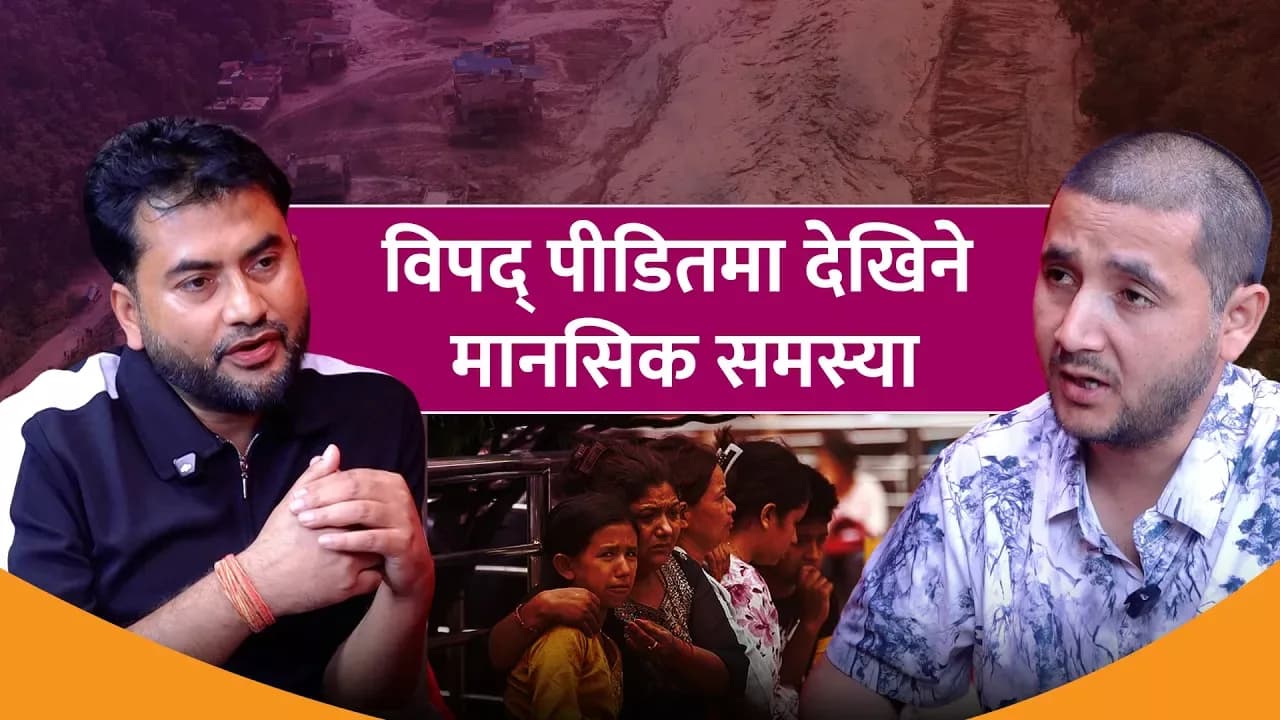
Kathmandu. The country is going through the disaster of Rasuwa flood. Any disaster not only causes loss of people's wealth, but also causes deep mental trauma. Disasters happen right in front of our eyes, loved ones are lost, disappeared, rescued from difficult situations. It has a multifaceted effect on the mind.
How to handle the fear, anxiety, insomnia and grief experienced by the victims after a natural disaster? How to make psychosocial counseling services effective at the local level? What to do to fill enthusiasm for life? Psychiatrist Dr. focusing on these issues. Edited excerpt of the conversation with Chibi Panthi (can be seen and heard in the extended video):
What kind of mental problems are seen in the victims of natural disasters like Rasuwa flood?
Disasters cause not only physical wounds but also deep mental injuries. Calamity does not come without warning. It is sudden and unpredictable. In such a situation, a person or a family has to lose their loved ones. In the pain of losing a loved one, a person initially thinks that 'I have not lost anyone' or denies it. At that time, his senses are blown and he does not know what is happening around him.
When the truth of the incident begins to be realized, anger arises in him, he becomes angry and the rhythm of daily life is disturbed. After this, the person mentally starts bargaining with himself saying 'I wish it had been this far'. When the effects of the incident start to become clear, the symptoms of depression can be seen in people. Finally, over time, he accepts that grief and reality. Only after acceptance can a person gradually return to a normal and comfortable state. Otherwise, it takes a long time for people to easily accept the difficult situation after the disaster.
What measures can be taken to manage the mental stress of victims who have lost relatives in the disaster?
When a disaster occurs, what is the reaction of people in the subsequent situation is very important. After the disaster, people start showing symptoms of physical and anxiety. For example, rapid heart rate, fear, anxiety, shaking of limbs, not knowing where you are and sometimes fainting or loss of consciousness (besura). Our body has an autonomic nervous system, which is controlled by sympathetic and parasympathetic pathways. In general, people adapt to the environment through these methods. But these methods cannot work regularly during disasters. As a result, people start experiencing various physical and mental problems. A person does not know what to do in such a situation. In the beginning, there are symptoms of insomnia, restlessness and anxiety. This is called 'acute stress reaction'.
This is the state of physical and mental symptoms seen in the person or his family members immediately after the incident. Its symptoms can be very unusual or unexpected. It is not that there is only one specific symptom, any kind of symptoms can appear. These symptoms include not sleeping, getting angry, throwing up, leaving the house and sometimes unexplainable or strange behaviors.
How can health workers, counselors and psychiatrists counsel the victims after reaching the disaster-affected areas?
There are people from different situations in the communities of disaster affected areas. People who already have mental problems and are taking medication are at high risk of missing medication or counseling due to a disaster, so they need immediate health care. Every person's ability to bear or feel pain (vulnerability) during a disaster is different. Health workers should reach the community level and work from house to house to bring out the pain and inflammation hidden in people and to identify and diagnose their problems.
Although there is not enough manpower in the field of mental health in our country, there are foundations that can be worked on by properly managing the available resources. But currently there is a lack of a clear structure (channeling) to connect mental health and counseling services within the government disaster management system, which needs to be organized immediately. After a disaster, people may experience various mental symptoms such as insomnia, anxiety, depression, paranoia or post-traumatic stress disorder. As soon as these symptoms appear, they should not be immediately labeled as mentally ill, because these reactions can also be temporary conditions created due to the disaster.
Since the effects of mental trauma can last for the first few days, weeks, months, and even years, disaster cannot be viewed separately from mental health. For complete health, all three aspects – physical, social and mental – should be healthy. The role of psychiatrists is important to correctly identify and diagnose whether there is any deviation or problem in a person's emotions, thinking/intellectual ability and behavior. Therefore, it seems very necessary for psychiatrists and counselors to stay in disaster-affected areas for a long time.
What are the measures of psychological first aid and counseling given to the rescue workers and victims after the disaster?
During a disaster, the scope of damage can be very wide. In such a situation, the rescuers involved in the rescue have closely observed the incident directly. There is a high risk that the rescuer himself will be scared, disgusted or mentally affected when he sees dead bodies in horrible conditions. Therefore, not only the local citizens affected by the disaster, but also all the human resources engaged in the rescue work are in dire need of counseling and psychotherapy. In order to make mental health services effective during such crises, it is necessary to correctly identify and prioritize the problems at the beginning, so that it is clear which problems should be solved with the first priority. In this way, the role of mental health and psychiatry is important in every stage of disaster management.
Why do the elderly, pregnant, children and disabled people need special mental care?
Pregnant women, the elderly, children, people with intellectual disabilities, and people who are already taking medication for chronic diseases such as diabetes (sugar), high blood pressure (pressure) or tuberculosis (TB) are at high risk (vulnerable).
At the time of a disaster, compared to normal or healthy people, the tolerance or ability to face the disaster (endurance ability) of the people who are at such risk is different, so the impact is more. Although physically healthy people are equally affected by disasters, this special group needs more care and attention.
How can mental care be delivered to those affected?
Social workers, teachers, women health volunteers, health assistants (HA), nurses and first aid doctors at the local level are the first contact persons of citizens. Since the number of psychiatrists is limited and they cannot reach all places in the disaster-affected areas by themselves, 'task sharing' should be done by giving the necessary training and knowledge about mental health to these local human resources. By doing this, they can identify the symptoms of mental problems and guide patients to access treatment and connect them to specialists. Therefore, expanding mental health services by creating a systematic network (channelized network) from the basic health institutions of the wards and villages to the district and provincial hospitals is an effective way.
What symptoms or conditions should the affected person be taken to a psychiatrist or hospital?
After the disaster, if a person has inappropriate or unnatural feelings (emotionally crying, screaming, crying), changes in behavior and thinking, it is necessary to consult an expert. In such a situation, people have problems such as having no appetite for food, not being able to sleep in bed, only the memory of a single unpleasant event or loss keeps wandering in their mind, and they are unable to sit still in one place or concentrate. As a result, it can lead to a situation ranging from not being able to manage stress to long-term flashbacks of old events and affecting daily life. Therefore, for the complete management of the disaster, it is essential to provide mental health services through an integrated team of health workers, psychiatrists and counselors along with physical and social rehabilitation.
Video: Ayush Dhami/Ratopati