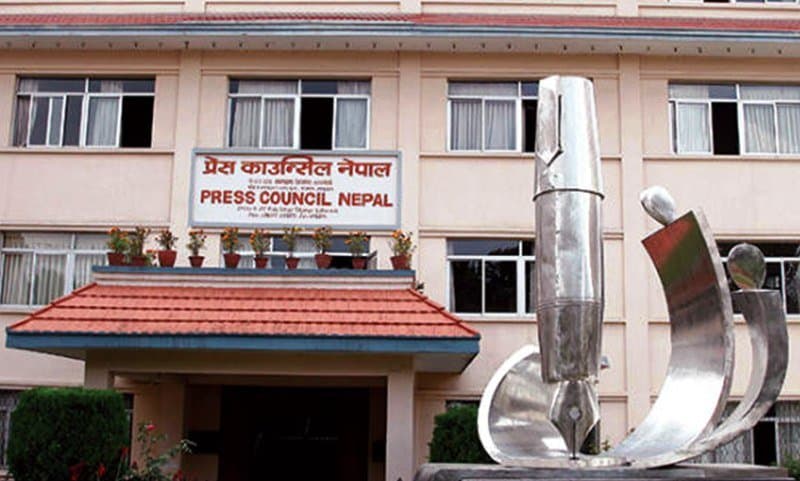
Kathmandu. The Press Council of Nepal has requested the journalists and the media not to publicize disturbing scenes, unconfirmed information, material that violates the privacy of the victims and sensational presentations while reporting news during the disaster.
The Council today issued the 'Editorial Guidelines on Positive, Humane and Responsible Communication in Times of Disaster, 2083' and urged to give priority to accurate, verified and life-useful information over competing news. According to the guidelines, the information regarding death, injury, disappearance, damage, risk area and rescue should be communicated only after confirmation from official or other reliable sources.
Mutilated corpses, gruesome scenes with visible body parts, scenes or images of excessive blood, faces of the dead, painful material of seriously injured people, and extremely private scenes of grieving families or children are generally not to be published or broadcast.
Due to extraordinary public interest, if a sensitive scene is used, it is instructed to cover the face or identity, limit the scene, give the necessary advance notice and use an alternative scene that is less harmful as possible. According to the council, before opening videos or content of digital platforms such as websites, Facebook, YouTube, Tiktok, Instagram, X etc., a small image that appears outside the main image or a short part of the audio that plays itself (thumbnail, cover or autoplay preview) should not be displayed.
It is mentioned in the guidelines that the victims should be treated as citizens with respect and rights, not just as a matter of news. When interviewing, it is asked to reveal the identity and purpose, to obtain informed consent as much as possible, not to pressure those who do not want to speak, and not to repeatedly question mentally disturbed people.
Prioritizing the best interests of the children, unnecessary 'close-ups' of crying or distressed children, private scenes with dead or injured relatives and personal details that could pose a security risk are requested not to be made public. According to the council, before republishing disaster-related content obtained from social media, five aspects such as source, place, time, reference and independent evidence should be confirmed.
Videos of old disasters, scenes from other countries or places, edited content, scenes created by artificial intelligence (AI), unconfirmed numbers of deaths or disappearances, and fake relief or government information have been asked to be especially cautious. When using AI-created symbolic scene, it is arranged that it should not be presented in such a way as to be confused with the scene of the real incident and it should be clearly disclosed as 'AI-created symbolic scene'.
The Council urged that disaster news should not be limited to death and destruction, but should also prioritize useful information on safe locations, weather and early warning, hospitals, relief centers, emergency contacts, rescue, rehabilitation and reconstruction. "Positive communication does not mean hiding the reality; it means showing the problem and also showing the way to recovery", the guide says.
During news gathering, it has been asked not to obstruct rescue, ambulance movement, treatment, work of security personnel or relief distribution, and journalists should not take unnecessary risks. As soon as it is known that wrong information has been published, it is mentioned in the directive that it should be corrected immediately, clarify what was wrong and what the correct facts are, and if necessary, apologize.
The council said that the media should also pay attention to the mental health of journalists, photojournalists, audio-visual editors and social media monitors who are constantly working on disturbing and painful content. Editors are also advised to conduct a '10 questions' test before publishing sensitive material, covering issues including fact-checking, security, privacy, children's welfare, visibility needs and public interest.
According to the council, attention, instructions or other procedures can be initiated in accordance with the journalist code of conduct, procedures and prevailing laws if content contrary to the guidelines is found.
National News Committee is the official news organization of Nepal.