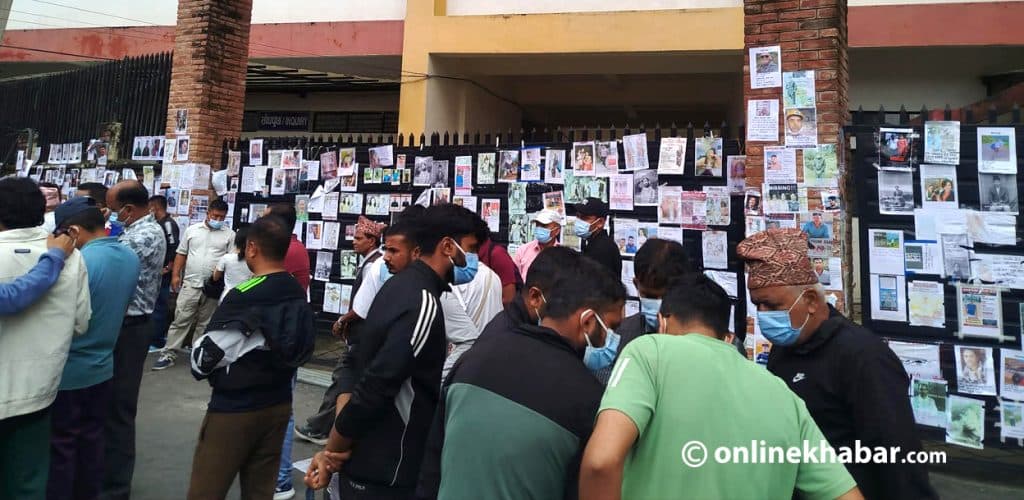
18 August, Kathmandu. A painful scene is seen outside the mortuary of Trivi Teaching Hospital Maharajganj.
Some are crying and looking at the pictures of their relatives while others are knocking towards the door of the mortuary. Someone's eyes are filled with hope, while someone's face is clouded with despair. Some relatives are dying on the ground because they cannot bear the pain of losing them.
Ambulances and hearses continue to come and go in the hospital premises. The security personnel wearing PPE and the youth involved in the rescue are busy taking the body out of the ambulance and taking it to the mortuary.
The biggest challenge here is not only to bring the body, but to identify it, keep it safe and finally hand it over to the right family.
After the dead bodies of people who lost their lives and disappeared due to the Bhotekoshi flood and other calamities were brought to the teaching hospital, the mortuary is now under pressure beyond its capacity.
Head of Department of Forensic Medicine of Teaching Hospital Dr. According to Gopal Chaudhary, in the latest data, 177 dead bodies have come to the hospital for management. Out of them, the post-mortem of 129 bodies has been completed. 85 bodies have been sent for temporary burial and 21 bodies have been identified by their families.
This number is much more than the capacity of the hospital. The teaching hospital has the capacity to keep about 150 dead bodies. That capacity has already been exceeded. Due to lack of space, about 31 bodies had to be sent to Pashupati's Chisyan Home in one day. Chaudhary says.
After 8-9 days, the body is not recognized by the face
The bodies of many people who disappeared in the flood have been found after a long time. Since 8-9 days have passed, most of the dead bodies have gone through the process of decomposition.
Its effect is evident in the appearance of the dead body. The face is damaged. Some are in pieces. It is difficult to identify even a corpse that looks whole by looking at the face.
According to SP Pradeep Singh, who is assigned to the dead body management at the teaching hospital, the situation of identification by looking at the face has almost ended.
"Some corpses can be identified by tattoos, special condition of limbs or other specific marks on the body," he says, "but most of the corpses cannot be identified just by looking at the face."
Therefore, efforts are being made to get identification from the relatives by placing pictures of dead bodies with special identifiable marks in the hospital premises. But it is difficult to identify the corpses that come in pieces even with pictures. This is the reason why DNA profiling has become the most reliable means of body identification.
Not the face, but the DNA
Although the external appearance of the human body is destroyed, the genetic information contained in the DNA does not disappear easily. Therefore, DNA testing has become important for the scientific identification of decomposed or dismembered corpses.
Dr. According to Chaudhary, the sample of the deceased is collected at the teaching hospital. The relatives' samples are collected at the pathology lab of the police hospital in Maharajganj.
A sample from the closest blood relative is useful for DNA matching. Especially when matching with a sample taken from mother, father, son or daughter, the probability of identification is high.
This process also saves the relatives from having to guess by looking at the dead body. Because, when the body of a person who died in a disaster is badly damaged, there is a possibility that relatives may misidentify under emotional pressure.
"The dead body cannot be kept outside"
As the number of dead bodies increases, storage has become a problem. Especially decomposed corpses should not be kept in open or normal environment. Due to the stench and biological risk from the dead body, it should be kept in a closed and suitable moist place. But the mortuary capacity of the hospital is limited.
"Decomposed bodies cannot be kept outside," Dr. Choudhary says, 'The bad smell spreads, the risk of infection increases. Therefore, there is an obligation to manage in a closed place within the limited capacity.
This has not only affected the mortuary, but the environment surrounding the hospital has also been affected due to the continuous handling of corpses. Patients, relatives of patients and other institutions nearby are also affected by the stench.
Continuous work for a week, fatigue in the staff
As challenging as the number and condition of dead bodies is, the situation of manpower to manage them is equally difficult.
For more than a week, doctors, police and staff have been continuously working with the decomposed bodies. They are working day and night amid stench, heat, biological hazards and mental pressure.
However, due to the limited number of forensic doctors, it is not possible to do sufficient rotation. Having to do the same kind of highly sensitive and mentally difficult work continuously, the physical and mental fatigue of the health workers and security workers is increasing.
Dead body management itself is not only technically difficult, but also psychologically difficult. On the one hand, there is an obligation to see the condition of the dead body, on the other hand, the relatives are waiting outside hoping to find their loved ones.
"Situation to bring all dead bodies to Kathmandu"
Teaching Hospital is the main center for postmortem of dead bodies from disasters in Kathmandu district, so the process of bringing dead bodies here from different districts continues.
Dead bodies are being brought from flood-affected districts. But when all the dead bodies are brought to Kathmandu at once, the pressure on teaching increases. Dr. According to Chowdhury, by deploying the police and doctors in the respective districts as much as possible, the arrangement for initial identification, sample collection and necessary legal procedures can be effective.
However, for that, forensic experts, necessary infrastructure and facilities for DNA sample collection should be available in the respective places.
Currently, that facility is not available equally in all affected areas. Therefore, bodies that cannot be identified or that require further forensic examination have been brought to the teaching hospital. The bodies that have been identified on the spot have been handed over to their relatives and sent there.
Another job of the police in the mortuary is to look at photos and identify them
Policemen are stationed in the mortuary. Since the same team cannot work with decomposed bodies for a long time, the police are working in shifts.
Outside, the relatives are looking for their person by looking at the picture of the dead body. Inside, the policemen are recording the details of the body. Doctors are busy with post-mortem and sample collection. In this way, the teaching morgue is not only a place to keep dead bodies, but it has become a center of identity.
The condition of the body, special markings on the body, clothing, jewelry or other details indicate possible identification. Then, as needed, the process of scientific confirmation through DNA testing proceeds.
Youth in cleanliness amid stench
In the teaching hospital's mortuary, the challenge of cleanliness is equally great along with dead body management. The environment around the mortuary has become uncomfortable due to the stench emanating from the corpses, which have been in a state of decay for 8-9 days, leaking blood and other organic waste. In such a situation, along with the task of bringing the dead body, taking it inside and assisting in the identification process, the responsibility of immediate cleaning has also been added.
A group of young people are now engaged in this work. They are trying to keep the area around the mortuary clean by using PPE, mask, sanitizer and phenyl.
They are doing the work of immediately cleaning the blood or other waste that has leaked out of the ambulance, washing the road and providing necessary assistance during the management of the dead body.
Due to the large number of dead bodies, the work is going on continuously. Youth have been mobilized in two shifts so that after one group has worked for some time, the other group will take over the responsibility. When many dead bodies arrive at once, the situation around the mortuary will be the same again in a short time, so the cleaning work has to be repeated time and time again.
Working in direct contact with dead bodies is not only physically difficult, but also mentally difficult. Some of the dead bodies are unrecognizably damaged and some of them are in pieces, so the youths who are involved in their management are also feeling uncomfortable.
However, they are working so that the families waiting for their relatives outside the mortuary do not suffer any more and the risk of infection and bad smell in the hospital premises is reduced.
This team, which has been engaged in rescue operations in Nuwakot and other areas since the beginning of the disaster, is now focused on dead body management. According to the team, the work is being done in coordination with the relevant agencies of the state.
The arrival of dead bodies is rapid, the departure is slow
Another problem in teaching is that the speed at which the dead body arrives and is handed over to relatives is not the same. The number of bodies coming from different districts is increasing. But because many bodies could not be identified, they could not be handed over to their relatives and sent. As a result, the pressure in the mortuary is increasing.
The identified bodies are handed over to the family. DNA samples are collected from the dead bodies that cannot be identified and after completing the necessary procedures, they are sent to temporary management. Meanwhile, the waiting time for relatives is getting longer.
A family waits inside a corpse
Behind every person standing outside the teaching hospital mortuary is a family. Some are looking for a husband, some for a son, some for a father, mother or brother.
Until the body is identified, their grief is incomplete. Therefore, now the question of dead body management is not only where to keep the dead body. The question is how to keep it safe, how to identify it scientifically, how to deliver it to the right family and how to dispose of the deceased respectfully.
The current work being done at the teaching hospital has shown that forensic medicine, police investigation, DNA technology, dead body storage and humanitarian sensitivity are simultaneously necessary in post-disaster management.
The flood separated people from their families. Now doctors, police and rescue workers are trying to connect the missing link again with the scientific evidence of DNA. And, outside the mortuary, the relatives are still waiting for the answer to the same question, "Is the body inside my man's or not?"
Online Khabar Correspondent Luitel writes on health and lifestyle topics.