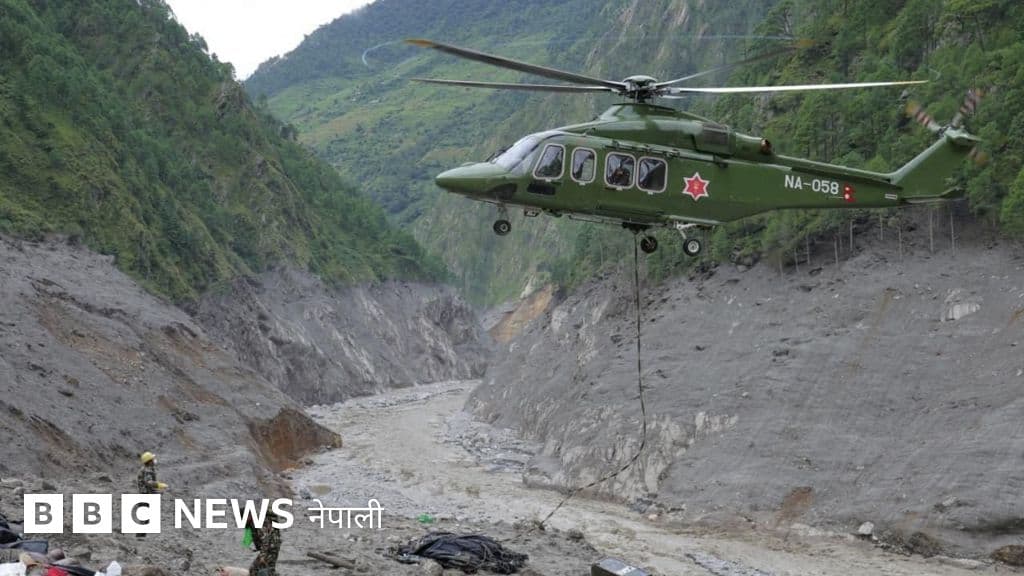
Image source, Nepal Army/Handout via REUTERS
While search and rescue operations are continuing in various areas affected by the floods in Bhotekoshi and Trishuli rivers, videos started appearing on social media from Saturday with the intention that some people may be in the Ghatekhola area of Rasuwa.
After that, many people started expressing interest about the condition of Ghatekhola and whether people were rescued from there.
Some such reports, analyzed by emergency services officials, claimed that people fleeing the flood may have been stranded in the forest.
"We were also told that there was a car, helicopters and drones were focused on it," Phanindra Prasad Paudel, head of the National Emergency Operations Center (NEOC) under the Ministry of Home Affairs, told the BBC while narrating the incident on Monday afternoon.
"The security personnel searched one forest after another. We even 'held' the helicopter for 19 minutes. We also monitored with drones. But nothing was found."
According to officials, the same videos posted on social media on the second or third day of the flood have not stopped spreading even now.
Officials of the National Disaster Risk Reduction and Management Authority say that such misleading information will affect the limited resources used in rescue operations.
"Those resources and means could have been used where there was a real need for rescue," said Shanti Mahat, spokeswoman for the authority.
"If we are to talk about searches with helicopters, it has happened many times. According to the relevant army officials, there have been cases where only one person has been found where it was reported that there are 500 people."
"In some places, people were not found even after doing Reiki several times. This has happened in high places including Rasuwagadhi," she said.
In the beginning, the video maker may have given the right information or posted it out of concern, but the spread of the same content for a long time is related to 'misleading information', experts say.
"It is not unusual for misinformation to spread during disasters like this and it has happened before," says Deepak Adhikari, editor of fact-checking organization Nepal Check.
"Misinformation is generally more prevalent during times of political violence or demonstrations, airplane crashes, and natural disasters."
"During a natural disaster, there is an 'information vacuum' at the beginning of the event, and as time goes on, there is an 'information overload'. The latter is now the case."
"It's been a week since the flood, even if it has reached the hills, people are taking some measures. Even walking because it's not far from Kathmandu. Those people may have been found, but old videos are being 'recirculated' and it creates a kind of fear," the official said.
Experts say that along with the flood scenes, various misleading videos have been circulated about the rescue work.
"Some of them are created by AI and some are videos from other countries," said the official of Nepal Check, "for example, a video from somewhere else came that Home Minister Sudhan Gurung was deployed in the tunnel for rescue work."
"As soon as the flood came, there was a video of Vietnamese children claiming to be from Nepal, in which a child was seen running towards the mountains with another baby on his back. It has been found that it is not from Nepal."
Similarly, along with the videos of the rescue work related to the tunnels of various hydropower projects in the Bhotekoshi-Trishuli Corridor released by the Nepali Army, similar videos are also coming on social media.
"I see that some people are uploading other people's videos without understanding the truth. Those who upload such videos have not even given full information," says the official of Nepal Check, "It is purely for 'monetization'."
"Some people are starting to say they wish they could turn off 'monetization' some day."
Assessing that a lot of misleading information can be spread on social media, the meeting of the National Council for Disaster Risk Reduction and Management held under the leadership of Prime Minister Walendra Shah after the flood created a separate cluster for monitoring and regulating social media activities.
Vijay Kumar Roy of Nepal Telecommunication Authority, who is leading the cluster, says that they have not entered much into 'fake' or misleading videos.
"We're focusing more on removing the kind of raunchy videos that affect people's mental health and on the topics that get reported."
In this cluster, together with Telecommunication Authority, Press Council, Cyber Bureau of Nepal Police, Security Center, Ministry of Communication are represented.
Experts say that misleading content on social media is harder to regulate than content published in registered media.
Press Council Nepal monitors and regulates the materials published in the media.
"But misinformation is coming more from lookalike social media than from mainstream media," said Ramsharan Bohra, co-spokesman for the council.
In the early stages of the flood, content claiming that "China released water from an artificial dam" also surfaced on social media. The Chinese embassy then responded to such "rumors and unconfirmed claims".
Such claims and content are said to be still circulating in some Indian media.
"Reliable information is lacking immediately after an incident, but people need immediate information. As reliable reporting comes in, many things become clear," said a Nepal Check official.
According to Roy of the social media cluster, after the government arranged that willing donors can send aid to the Prime Minister's Disaster Relief Fund, some people have been misusing it and trying to do 'phishing'.
"In the name of the relief fund, people have given their own QR code. We alerted people about it through SMS."
"…Ensure that the account, QR or link is official before sending funds for assistance," said the bulk SMS issued by the council.
"It has had a good effect. We sent the message on Sunday, and since then there have not been many complaints," Roy told the BBC on Wednesday afternoon.
"There have been no complaints about other misleading content so far, we will look into that as well."
According to experts, misinformation during a disaster can spread fear and confusion as well as hinder rescue and relief operations. Not only that, it can also put people at risk by making wrong decisions.
"One should not post or share information on social networks without being sure about the source of the information," says Nepal Check official, "It is the responsibility of each of us."
"At this time, security agencies and disaster authorities are doing their own work, but unfortunately we don't have a centralized information system. For example, the number of missing people on the government web portal varies."
"Had there been such a system, people could have used it as a basis for information," the official said.
BBC News Nepali is also on YouTube. Click here to subscribe to our channel and watch published videos. You can also find our content on Facebook, Instagram and Twitter. And you can listen to the program of BBC Nepali Service at nine o'clock in the evening on the radio from Monday to Friday.