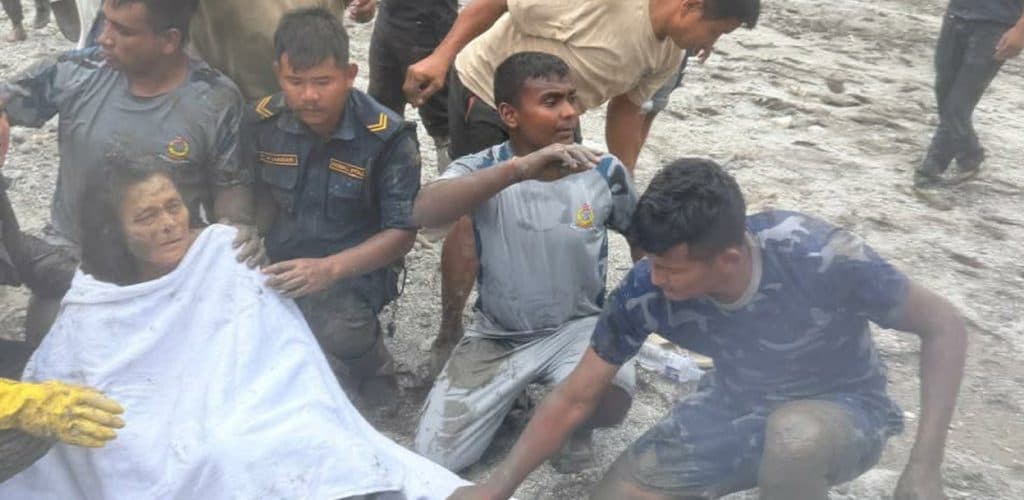

16 August, Kathmandu. According to the experts, about 2.5 million cubic meters of snow and ice fell down about 2000 meters due to glacier collapse, which is considered to be the cause of Rasuwagadhi flood.
Professor of the Central Department of Geology of Tribhuvan University who is studying avalanches and floods in Langtang Lerung North. According to Ranjan Kumar Dahal, not only did the pile of snow fall down, but there was an explosion causing extensive damage to the surrounding area.
"Looking at the satellite data and calculating a very low rate based on that, it seems that two and a half million cubic meters of snow fell down," Dahal told Online Khabar, "The energy of that snow mound falling down about two thousand meters must have had the same effect as a bomb explosion." It was also measured as a 5.2 Richter scale earthquake.
Dahal, an engineering geologist from Tribhuvan University, along with professors from Twanji University in Shanghai, Cambridge University in the UK and King's College of London, University of Padua in Italy, started a study about the movement in the Himalayas and Himalayan regions for a year.
Supraglacial lakes (newly formed small pools and ponds in the glaciers) of Purepu Himtal on the upper Tibetan side of Rasuwagadhi erupted, due to which the Bhotekoshi river flooded last year as well.
After that, a team of geologists and scientists started studying the movements and activities in the glaciers of the Himalayan region. While the same study was going on, a devastating flood occurred last Wednesday, after which some members of the team focused on the study of avalanches and floods.
According to Professor Dahal, analyzing the satellite data he received, the length of the avalanche is about 1.3 km. That landslide has carried a part of 500 to 800 meters downwards. "But from that we are not able to measure the thickness of the mound clearly," says Dahal.
When calculating the volume of the fallen mound, it is seen that about 40 million cubic meters of snow and ice fell down. However, Professor Dahal estimates that 2.5 million cubic meters of debris fell down, even though he underestimated it. Others have given preliminary estimates of 100 million cubic meters of snow.
How big is the 'mass' of two and a half million cubic meters, it is enough to fill London's Wembley Stadium 22 times. It is 10 times bigger than the pyramids in Egypt. Scientists working on the import of snow say that the volume of fallen snow could be even more than this.
Not only did the snow fall, but all the effects were like a powerful bomb. Even the eyewitnesses have said that it was like a bomb went off. Dahal says, "After that, the scattered gas, water and pieces of stone reached the Dobhan area on the Nepal-China border in Rasuwagadhi at a high speed."
In the CCTV footage released from China behind the Kerung Customs and Immigration Office, it is seen that the flood that fell at high speed and hit the hill in front of Ledo and immediately damaged that structure.
Some experts have said that the flood occurred at a rate of 120 kilometers per hour while spreading about 12 kilometers from the landslide area of the Lhende River to the Customs House.
The character of Rasuwagadhi flood was of a different nature as only the scene of a large amount of water flowing in a stream or river comes to mind when the word flood comes to mind in Nepali society. Quoting the statements of eyewitnesses who drowned their houses in a moment without even thinking about the flood coming from above, it is also called 'Tsunami from the sky', 'Himali Tsunami'.
Professor Dahal says that the speed and damage caused by rock-ice avalanches made of rock, geyser and ice is unimaginable.
Since it is a place where there is no human activity, the flood scenes and photos from Lhende River to Rasuwagadhi are not found on social media. But in the videos below from Rasuwagadhi, the river area was flooded in such a way that it looked like fog.
Professor Dahal estimates that the speed of flooding has decreased after Rasuwagadhi. According to him, the avalanche that hit the ground and exploded was at a high speed until it reached Rasuvagadi, after which the speed slowed down. After reaching Betravati, Trishuli and Devighat, the speed slowed down due to flat terrain.
According to the released satellite data, a small ice lake has been formed in the place where the snowdrift has fallen, which Chinese experts call Barrier Lake-2. Another long lake (Barrier Lake-1) was formed at the edge of Lhende river, after it was filled, another flood occurred in Bhotekoshi two days ago. The Chinese government has now said that the lake has been drained.
According to Professor Dahal, it is assumed that when the original avalanche fell, it absorbed the surrounding water and other sources of snow and fell down. On the same day, a few hours later, a video of another landslide was released on social media.
Professor Dahal says that two days later another small landslide occurred in the same place. According to him, one of the experts in the study team is an expert in analyzing data from the model. He is studying the shape of the snow and ice piles before the incident. Dahal says, "We are planning to release some details about this in another two/three weeks."
According to geologist Dahal, recently, the surface of the land around the Langtang mountain has been heating up and cooling again.
He concluded from the data analysis provided by the ERA-5 satellite that the land surface is continuously rising.
ERA-5 monitors temperature data two meters above ground level. Dahal says that during the study, the temperature of the last two years was higher than the average temperature of the last 25 years.
According to the figures released by him, the temperature of the ground in Langtang area has varied by 20 degrees Celsius. At one time it was minus 12 degrees Celsius and at other times the temperature reached up to 8 degrees Celsius.
Dahal says that since there is no station to monitor the weather and environmental conditions of Langtang and there is not much infrastructure around it, since the Chinese side has not established an early warning system, they are trying to analyze the situation based on satellite data.
Looking at the data, it is seen that the temperature there is fluctuating a lot. We are looking at the effect of the same thing on the snow and glaciers there.
Gyawali, who writes on judicial and government matters, compiles investigative content in online news.