The presence of Nepali cycling on the big stage of the Asian Games is not just an ordinary participation, it is also a story of self-respect. Looking back at the early decades, the footsteps of Nepalese riders seem to have witnessed a kind of imperfect but unprecedented courage. On the one hand, athletes from economic and technological superpowers like Japan, China, and South Korea rode at lightning speed on modern, state-of-the-art aerodynamic bicycles that beat even the wind and screeching international tracks. On the other hand, our Nepali riders used to descend with only the guts inside their chests and the sweaty experience they shed on the unpaved roads of the villages, in the face of extreme lack of infrastructure and typical Bazaria bicycles. In that unbalanced and uneven battle, when the strict technical rules of the time limit were enforced, the main peloton would overtake our players and the cruel tag of “Did Not Finish” (DNF) would be hung on the screen. That DNF was not just a technical defeat or an exit from the race, it was also the brutal end of thousands of dreams woven between limited resources and scarcity.
Every DNF used to hurt the hearts of the athletes, but those disappointing defeats never let Nepali sports to its knees. Instead, he paved the way for a new approach, deep introspection and revival. After that impossible and disappointing phase of road and track cycling, Nepal Cycling Association took a revolutionary leap in strategy towards the end of 2000s. Instead of competing on foreign tracks with state-of-the-art velodromes and millions of bicycles, he took a bold decision to focus on 'mountain biking' that is suited to the soil, geography and natural structure of his own motherland. The vast, steep, steep, difficult and rocky Himalayan and mountain terrains of Nepal have become a world-class training center provided by nature for free for Nepali riders. The successful hosting of the Asian Mountain Bike Championship held in the tough hills of Chobhar made the confidence of Nepali cyclists as high as Mount Everest. After that, Nepal showed its true potential and talent to the international world by capturing historic gold and other medals in both male and female categories in the South Asian Games (SAG). After hoisting the flag of Nepal on the podium beating the South Asian teams, Nepali cycling has gained a strong and unassailable foundation to enter the big and challenging canvas of Asian Games with renewed confidence.
The 2018 Indonesia (Jakarta-Palembang) Asiad witnessed a golden rebirth in the history of Nepali cycling. A team of two determined male athletes competed in a technically challenging and risky cross-country and downhill race and successfully crossed the finish line without any 'lap-outs'. This success was no less than a historical medal, because it completely erased the black shadow of 'DNF', which has been haunting Nepalese athletes for the past decades, from the pages of history. Then, at the 2023 Hangzhou Asiad in China, a balanced team of men and women got a historic opportunity to compete shoulder to shoulder with the world's best athletes to measure their weaknesses and timing against Olympic standards. Even today, serious challenges such as the high cost of carbon-fiber bicycles, the lack of modern velodromes required for track cycling, and limited international experience remain as mountains. However, for the 2026 Aichi-Nagoya Asiad, the National Sports Council has taken a firm decision to turn regional dominance into continental success by putting cyclists in special closed training. This journey is not only a limited goal of winning a medal, but it is also a unique example of the Nepali spirit of standing tall before the world with the strength of its own geography and the indomitable courage flowing in Nepali blood, overcoming countless obstacles.
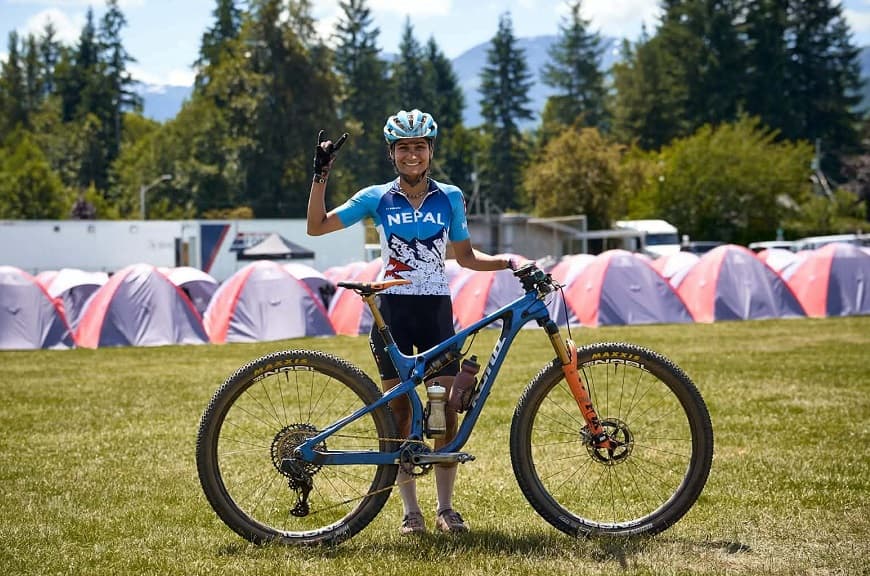
The exciting cycling competitions at the 20th Asian Games are being conducted on September 24 and 25. For this, Devendra Basnet, the head coach of the Nepali cycling team, who is undergoing strict closed training, has a new ray of hope and faith shining in his eyes. According to him, Nepal is participating in the highly prestigious and challenging 'cross country', which is an Olympic sport under mountain biking. In this team, the nation's trust Navraj Neupane on the men's side and Usha Khanal the indomitable courage on the women's side, two promising players are carrying the red and blue flag of Nepal. Basnet says that the current training plan of the players is progressing very enthusiastically and they are practicing hard every day in different geographical environments. For training, the team has been using the multi-faceted race course in Jadibuti in Kathmandu, the natural trails of Gokarneshwar municipality and indoor sessions.
In order to improve the physical fitness, endurance and muscle strength of the players, high-level gym sessions are being conducted continuously at the CASC club of the Nepali Army at Lagankhel, Lalitpur. The men's players are sweating blood and sweat in closed training at home, while the women's player Usha Khanal is currently training abroad in the cold climate of Canada, from where she will directly reach the competition venue and join the Nepalese team. If there are no future technical complications such as punctures, severe crashes or mechanical problems, coach Basnet is fully optimistic that this time there will be a much better and record-breaking performance than the previous China edition. However, accepting the reality that more effort and a long journey is required to win a medal at the continental level, he is now focusing on his best performance rather than claiming a big medal.
Nepali mountain bike female athlete Usha Khanal is currently training in Canada to raise the name of the country on the grand stage of the Japan Asian Games. She says that her level has improved because there are strong competitors in Canada compared to Nepal. She said, "Even though there are some financial problems, the training is going well. Since the professional women cyclists are training together in Canada, it has become easier to understand their level and to improve it. Even though the monsoon is going on in Nepal now, the condition of the cycle track is not improving, that's why the training in Canada has made me comfortable now. Due to health problems in the last 19th Asiad, I was unable to complete the race, but this time I will try my best to improve the old shortcomings and bring good results."
Similarly, another Nepalese player who is training in Nepal, Navraj Neupane, is busy with intense preparation and strict closed training day and night. For the past one month, he has been working to realize the biggest dream of his life, staying in a hotel and staying under the discipline of closed training. According to Navraj, the team has been practicing regularly for three hours in the rough and steep hills of the Chobhar area in the morning and for one to two hours in the evening to raise the heart rate regularly. Training does not stop even during bad weather or heavy rain. On such days, sweat is shed on the indoor roller. In order to bring the stamina and physical endurance of the players to the extreme limit, they have been practicing cycling for a long and difficult distance of 80 to 100 km on the challenging road towards Dhulikhel one day a week.
Highlighting the complexity of his main competitive category 'Cross Country', Navraj says, - "This sport is not a normal road race, it is played in a tough lap system of 3.5 to 5 km on a tough outdoor route in natural and wild areas." In this genre, the players have to deal with different technical challenges from moment to moment like Bhimkaya rocks (rock section), difficult turns that can lead to loss of control and dangerous jumps that have to fly in the sky. His experience is that the food, accommodation and other arrangements in the camp are excellent, so the training is progressing very efficiently and energetically. For the first time in his entire life, Navraj, who is about to step on the big stage of continental sports like the Asian Games, has a strong desire to do something for the country. He expresses great confidence that he will give his 100 percent best performance in the competition and adapt to any difficult situation of the route and will perform with determination till the last breath to get a medal for Nepal. In fact, this spirit of his is not only a cycle race, but also a flight of a golden dream born from the soil of Nepal, the heart of Nepalese and the culmination of struggle.