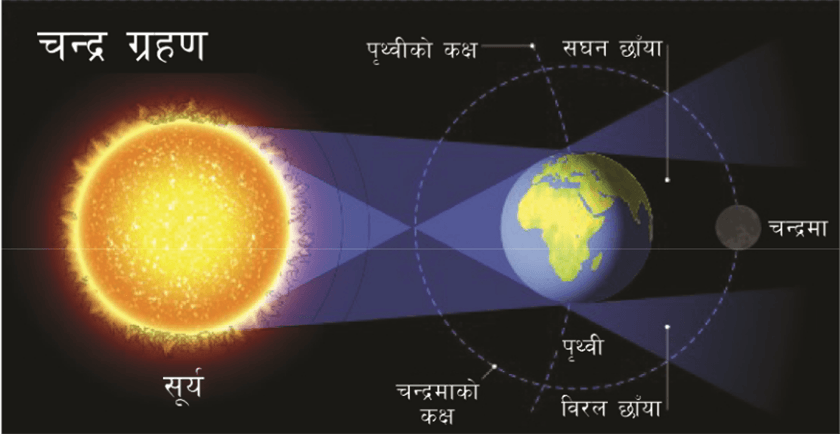
Kathmandu - On the day of Ashad Shukla Purnima, the Khandgras (half moon covering) lunar eclipse is happening on Tuesday. Prof. Dr. Ramchandra Pokharel, Chairman of the Nepal Panchang Jury Committee informed that the eclipse will touch from the southeast angle (between east and south) from 1:46 pm. The middle period of the eclipse will be at 3:15 am. He said that mokshakal or eclipse will happen at 4:45 in the morning.
It is classically believed that an eclipse in Uttarashadha Nakshatra is troublesome for Sagittarius and Capricorn. These two signs should not see the eclipse. Likewise, it is mentioned in the calendar (almanac) approved by the committee that people with Aries, Taurus, Gemini, Leo, Virgo and Scorpio signs should not watch the eclipse. Cancer, Libra, Aquarius and Pisces will see the eclipse.
It is considered auspicious to perform rituals such as bathing, charity, Shraddha, chanting, meditation and sadhana during eclipse. It is also considered best to take dikshamantra during an eclipse. It has been mentioned in religious texts such as 'Nirnayasindhu', 'Hemadri', 'Kalmadhav', 'Veeramitrodaya' that one should bathe in nearby rivers, lakes, ponds, ponds and if not possible at the time of eclipse.
It is described in the mentioned religious texts that if you sleep during the eclipse, you will get sick, if you urinate, you will be poor, if you defecate, you will be born as a worm, if you have intercourse, you will be born as a village pig, if you groom yourself, you will become a leper, if you eat, you will become degenerate, if you are bound, you will be born as a snake, and if you kill someone, you will live in hell. According to the theologian Gautama, Sutak begins four praharas (12 hours) before a solar eclipse and three praharas (nine hours) before a lunar eclipse.
There is a religious belief that one should not eat food after taking Sutak. From 4:46 pm on June 31st, food is prohibited except for children, old people and sick people according to classical belief. The world-famous scientist Einstein used and confirmed his theory of light during a total solar eclipse.
For astronomers and scientists, the eclipse is a golden opportunity to confirm an experimental process, said Jayant Acharya, a senior astronomer at Valmiki Campus. It is said that the effects of the eclipse can be experienced not only on humans but also on animals. It is said that there will be a total of eighty-five lunar eclipses in the twenty-first century.
Modern and scientific views on eclipses
The Nepal Astronomical Society has said that if the weather cooperates, a partial eclipse of the Earth's shadow on the moon can be seen from all parts of Nepal. According to the Gregorian calendar, the eclipse will occur on the morning of July 17 and on the night of June 31 according to the Nepali calendar. According to Nepali calendar, the time from sunrise to sunrise is counted as one day. Suresh Bhattarai, president of the society, informed that the time has changed because the Gregorian calendar counts the time from midnight to midnight as one day.
The society also said that those who want to observe the lunar eclipse can safely observe it with their naked eyes from their house or the open square next to their house. Chairman Bhattarai said that there is no harm in observing the lunar eclipse according to scientific belief. The lunar eclipse, which begins at 1:46 p.m. on Tuesday, will eclipse the moon at 3:15 p.m. If it was completely covered, it was called straw.
Observers will be able to see part of the moon in copper color from 1:46 am to two hours and 58 minutes ie 4:44 am. This period itself is known as Khandagras lunar eclipse. The eclipse can be seen from India, China, Mongolia, Japan, Russia and Africa, South America, Europe and Australia, including Nepal. People living in Canada and North America will not be able to experience the eclipse, said Valmiki Vidyapeeth Associate Professor Acharya.
He said that this is one of the 85 lunar eclipses in the twenty-first century. "Tantriks use this time to practice Tantra and Aghori mantras believing that they will be successful during eclipse," he said. While watching a solar eclipse, various precautions are taken to prevent the rays from the sun from entering the eyes. A lunar eclipse can easily be seen by anyone with the naked eye.
Lunar eclipse viewing will not be affected by telescopes, binoculars, cameras or any other equipment. During the lunar eclipse, there are no harmful rays to the eyes. Rasas
Published: 30 June 2076 13:40 Monday