
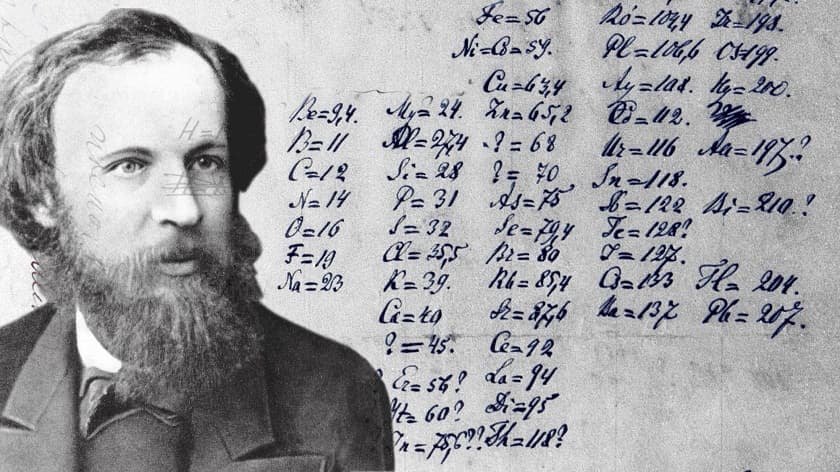
I knew his work before that Russian old man. His name is difficult - Dmitri Ivanovich Mendeleev. We memorized his theory and name together. Otherwise, Dharmapal sir would have been kicked. Kanthai was - 'The physical and chemical properties of elements are a periodic function of their atomic weights.'
Dharmapal Choudhary from Kapilvastu Krishnanagar came as our science teacher when we were studying seventh grade in Arghakhanchi government school. He had not arrived alone. Along with him came some science materials - test tube, measuring cylinder, aluminum foil, pan balance, burner, acid bottle, copper sulphate, litmus paper, etc. One of them was a table with English letters written in different colors, the secret of which we did not know.
After reaching the eighth grade, some names suddenly appeared in the science books. Those names were unique and interesting. A little fear of head-banging and a little curiosity we memorized those strange names – hydrogen, helium, lithium, beryllium, boron, carbon, nitrogen, oxygen, fluorine, neon etc. Laskar with this unique name was also unique.
The number of hydrogen was one. Two of helium. Three of lithium. And eight of oxygen. Why do these elements also have the same number as our roll number in the class? We didn't know. In the attendance book of the class, the first in the previous class was number one. Was hydrogen also the first among these names? "Not like that", said Dharmapal Sir, "It is based on a rule. You will know when you reach class 10. Remember the basics now.'
In the attendance book of the class, the first in the previous class was number one. Was hydrogen also the first among these names?
We just waited for class 10. And we started remembering the basics. The basics are – elements combine to form compounds. The smallest part of a compound is a molecule, the smallest part of an element is an atom. Hydrogen and oxygen are elements. These two together form a compound called water. These atoms take part in chemical reactions. For example, water consists of two atoms of hydrogen and one atom of oxygen.
Why do these atoms combine, how do they combine? We had no idea. Dharmapal sir had only one rattan – wait till 10th standard. Remember the basics now. Was the basic too low? After ninth grade we memorized the physical and chemical properties of hydrogen, carbon and oxygen. And piles of chemical equations.
This Russian old man arrived just after the tenth grade. But I knew his work before his name. The colorful table that Dharmapal sir brought from the city was the product of this old man's brain. Where one hundred and nine elements were standing like young men standing in line for recruitment with numbers pasted on their chests.
Dharmapal sir introduced us to that schedule. Name: Periodic Table Born: Russia Father: Dmitri Ivanovych Mendeleev (same) Born: 1869
This table held the secret of all the curiosity that had awakened since the seventh grade. This was the answer to all the questions. However, Dharmapal sir did another strange thing - 'The periodic table I showed was not made by Mendeleev.'
We got another shock. There was also a table made by Mendeleev in the science book. Many errors in that table were corrected and the present table was made. Where did the story end? We had to memorize those errors as well. And had to memorize the characteristics of Mendeleev's table.
This must be memorized in any case. We must know about this because it is the milestone of the modern journey of chemistry.' - Dharmapal sir said. Unfortunately, Dharmapal sir is no longer with us. But I kept missing him time and again as I carried my chemistry books till my graduation.
Because, he had told the sixteenth truth. This table was at the heart of chemistry. Whose father was – Mendeleev. A large part of Mendeleev's physical body may have been mixed with natural carbon. A little magnesium, potassium. His bones may have dissolved into calcium in the soil beneath his grave. But the table he drew is now one and a half hundred years old. Lakka Jawan because chemistry still has a long way to go. And this table will live for thousands of years yet. Is not one and a half hundred years in the life of thousands of years the beginning of puberty?
Introduction The periodic table is a list of elements found in the world. It has a symbolic name and number for each element's atom. For example: Hydrogen is denoted by J and its symbol number is 1. That number is called the atomic number. If you look carefully at the periodic table, you will find 1.01 written in small size under the capital letter H. That is the mass of an atom of hydrogen called the atomic weight.
Note that the lightest naturally occurring element is hydrogen and the heaviest is uranium with an atomic number of 92 and an atomic weight of 238.02. There is an element heavier than uranium in the world - unankotium. But that is man made.
A deeper look at the periodic table is like magic. Once you stick to a rule, like turning a calendar, elements of the same quality start to repeat themselves.
Here are some basic introductions to the periodic table. First of all, it is a classification table based on the properties of all elements known so far. It has two types of lists. Vertical and horizontal. A vertical list is called a group. Elements with similar properties are placed in a group. Like a sheep to a sheep, a goat to a goat. For example, the group containing hydrogen includes elements such as lithium, sodium, potassium, and rubidium. All these elements are among the active elements of the table. This group of hydrogen is named 'alkali metal'.
There are 18 such groups in the periodic table. Each group has similar elements. On the far left are metals. Going from left to right, properties of metals decrease and properties of non-metals increase. The last group on the right is the helium group. The elements living in this group are like the neighbors of the city who are all over the place - they live together, they don't get along with anyone, they don't react. Hence it is named inert gas.
There are seven Tersa Laskars in the table. This is called a period. A period is a time or interval. As the same season repeats after certain interval and based on that interval the calendar is formed. Similarly, in this table too, after passing a certain interval, elements with the same properties are repeated. And a new interval i.e. period begins.
Going from left to right in the periodic table, when all the groups are finished, a new period begins and elements with the same properties start repeating. As in period one are hydrogen and helium. Lithium, the third number after helium, belongs to the first group of the two, i.e. the hydrogen group, and the properties of these two are similar. And after placing beryllium, boron, carbon, nitrogen, oxygen, fluorine and neon, sodium with the same properties comes again.
The importance of this table became more and more understood as the higher classes of chemistry were studied. Every time I divided each group and read their properties, I thought, if I had to read the properties of all these elements separately, how many times would my back be broken? But Mendeleev laid the foundations of the periodic table. This is where the periodic table came from following the path he dug.
As Dharmapal Sir said, the current periodic table is different from Mendeleev's because its basic principle is different. Mendeleev believed that the properties of elements repeat after certain intervals of their atomic weights. But that rule didn't work for long. The rules of the modern periodic table state that the properties of elements repeat after certain intervals of their atomic number.
The rules have changed. The schedule has changed. A new schedule has been created. But chemistry has not stopped following the path Mendeleev dug. However, this journey began before Mendeleev.
Prehistory: It is difficult to say exactly where the history of the periodic table begins. One of its starting points is probably Lavoisier. After the success of the French Revolution, he was guillotined with the conclusion that 'the republic needs neither scientists nor chemists'. His fault was, he used to farm tax. Other tax collectors were cut along with him.
But he was different from others. Because, he spent his accumulated wealth to build the best laboratory in Europe. This is probably where the periodic table was born.
Together with his wife Marie-Anne, Lavoisier discovered how substances change in chemical reactions. Based on that, they also made a list of chemical substances. The list of elements published by Lavoisier in 1789 is the first list in the history of chemistry. 33 elements were named in that list. That is one in five of the elements discovered so far. Elements like gold, iron, sulphur, and silver were already discovered at that time.
Lavoisier's most important discovery was the principle of conservation of mass. He discovered that in a chemical reaction, the properties of substances change, but the total weight of all substances participating in the reaction is equal. Further refining this principle, another French chemist, Louis Joseph Proust, proposed the 'Principle of Fixed Proportions' in 1794. The construction of this recognition is a great leap forward in the development of chemistry.
Proust's theory opened the way to the assumption that something else plays a role in chemical reactions rather than the elements themselves.
John Dalton discovered that such objects are atoms. He said, while disintegrating any element, it stops disintegrating after reaching such a point - atom. That is, the smallest form of an element is an atom. Just as the gold we see is made up of numerous elements of gold.
The same meaning is hidden behind Dalton's naming of atoms. He named the atom from the Latin Atmus. Atmos in Latin means indeterminable.
His entire work was based on the atomic weight of hydrogen. Dalton's work was immediately adopted by the Swedish chemist Jacob Berzelius. It was Berzelius who created the way of writing the formulas used in chemistry today. He developed the system of writing H2O for water, H2SO4 for sulfuric acid (acid), and NaCl for table salt.
On the other hand, Humphrey Davy was working on electrical disconnection in Britain. Davy discovered elements like magnesium, calcium, strontium, barium, boron. What he found is that sodium and potassium show the same properties. The properties of calcium and strontium are the same. The properties of sodium and potassium are the same.
In 1829, German chemist Johann Dobrenier discovered that sulfur, selenium and tellurium have the same properties. What he found is that if sodium, strontium, bromine and selenium are arranged according to their atomic weight, the weight of the middle element is the average of the weight of the other three. This fact was the first opening of the mystery.
In 1864, another chemist named John Newlands discovered a new fact. He said that elements can be put in a series like the saregampadhanisa of music. He placed the elements from potassium to bromine on a similar basis.
Thus, before Mendeleev created the periodic table, a lot of work had been done. And all that work was done on the basis of atomic weight. It was there that Mendeleev caught Mio.
Birth story of the periodic table: Mendeleev was born on February 8, 1834 in Siberia, Russia, called the edge of Western civilization. He was the youngest of more than a dozen children of his parents. Ba was a retired high school teacher whose pension was barely enough to feed a large family. So Mendeleev's mother worked as a manager in a small factory run by his brother.
In 1848, the factory burned down. Mendeleev's father also died in the same year. The following year, the mother took Mendeleev and his brother to Moscow. Mama helped them there too. In 1850, Mendeleev entered St. Petersburg University. Alexander Voskrensky, a professor there, got him interested in chemistry.
In 1856, he completed his master's degree. Then he went to Heidelberg University in Germany. He participated in various researches there for some time. In 1860, he participated in the Karlsruhe conference held at the same university. Italian chemist Stanislau Cannizzaro introduced the concept of atomic weight for the first time at that conference.
In 1861, Mendeleev returned to St. Petersburg University. There, along with teaching, he also started writing chemistry textbooks. After completing his graduation in 1865, he was appointed as a professor of chemistry in 1867. Even after becoming a professor, he was busy writing textbooks. His biggest complaint was that there were no mobile textbooks in Russian.
On February 14, 1869 (according to the Russian calendar, February 26 according to the Gregorian calendar), he was still writing the textbook. But it was Friday. He had to go to the village. Going there, he wanted to do some research on cheese making.
Even while walking in the village, elements and their qualities were playing in his mind. It was then that his mind clicked. Can the elements be arranged on the basis of their atomic weights?
He made a random card of the 63 elements discovered up to that time and tried to arrange them in an order. In the book "Principles of Chemistry" published in 1905, he expressed his experiences while making the periodic table in this way - "I wrote the atomic weights of each element, their main properties, and other elements in combination on a card. Looking at all these, I found that the properties of elements depend on their atomic weights.
Thus was born a table that taught us to group the elements that make up the world.
The truth that Mendeleev did not see from the current stage of chemistry, there are many errors in Mendeleev's table. Mainly, hydrogen is not given the right place in it. All the isotopes of the elements are kept together. Atoms with the same atomic number but different atomic weights are called isotopes. Hydrogen has three isotopes. Such was the problem with classification based on atomic weight.
These errors of Mendeleev's periodic table have been solved by the modern periodic table. For that, the modern periodic table relies on atomic numbers. The principle behind the modern periodic table is that the physical and chemical properties of elements repeat according to their atomic number.
Chemistry has taken many leaps to reach this conclusion. Radioactive elements were discovered before this new table was created. Learned about sub-atomic particles like electrons, protons, neutrons. And the biggest thing is that the chemical reaction is the exchange of electrons of atoms. In essence, new facts discovered in the early 20th century gave birth to the modern periodic table.
Of course, the weakness of the 19th century was corrected by the 20th century. But the road was dug right away. That work was done by that Russian old man. Today it has reached one and a half hundred years. Cheers Periodic Table!
Published: 2 Chaitra 2075 07:28 Saturday